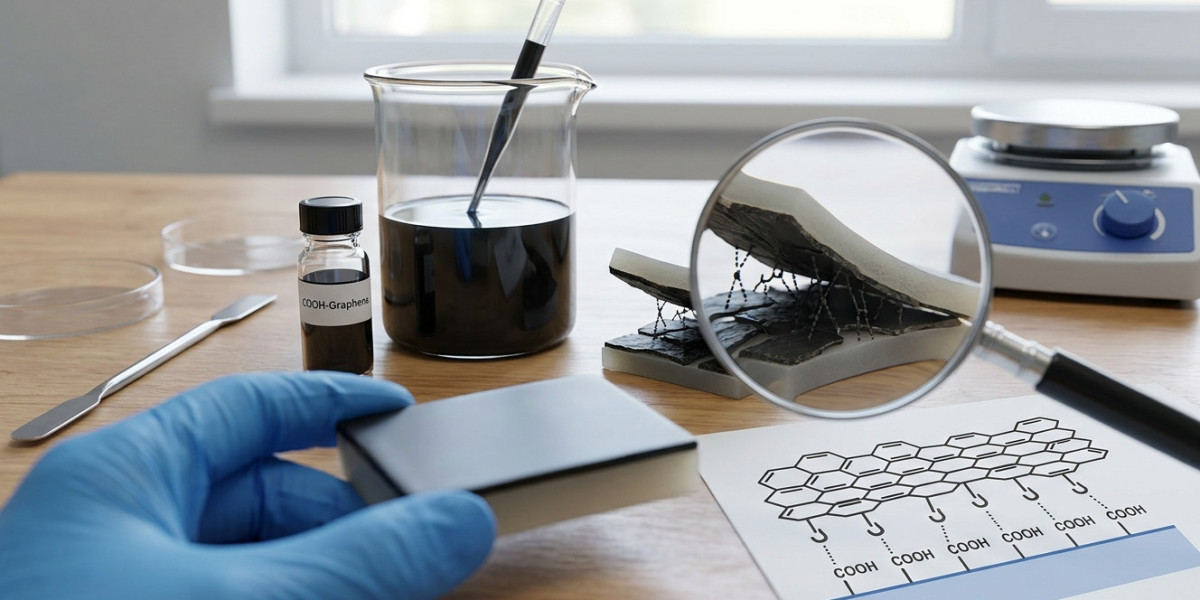

Adhesion defines how well materials stay bonded under mechanical stress, environmental exposure, and long-term use. In advanced coatings, structural composites, and electronic assemblies, weak adhesion often leads to delamination, microcracks, and early failure. Therefore, engineers now focus on improving molecular-level bonding rather than relying on bulk additives. This is where carboxyl graphene delivers measurable value.
This functionalized graphene contains carboxyl (-COOH) groups on its surface. These groups change how the material interacts with polymers, resins, and substrates. Instead of behaving like an inert filler, it becomes chemically active. Because of this, it enhances adhesion through controlled surface chemistry, improved wetting, and stronger interfacial mechanics.
Let’s break down how this material strengthens adhesion in a precise and practical way.
Surface Functionalization That Drives Chemical Bonding
Carboxyl graphene introduces polar functional groups that actively react with surrounding materials. These groups form strong chemical interactions with hydroxyl, amine, and epoxy functionalities present in most polymer systems.
At the molecular level:
Carboxyl groups create covalent bonds with reactive polymer chains
Hydrogen bonding networks develop at the interface
Polar interactions improve compatibility with hydrophilic matrices
As a result of these reactions, the interface becomes chemically integrated. It does not behave like two separate layers. Instead, it forms a continuous bonded system.
This directly increases interfacial shear strength and prevents premature failure under load.
Surface Energy Enhancement and Wetting Control
Adhesion depends heavily on how well a material spreads across a surface. Carboxyl graphene increases surface energy due to its polar nature. This reduces the contact angle between the matrix and substrate. As a result, wetting improves significantly.
From a technical standpoint:
Higher surface energy improves liquid spreading
Reduced contact angle increases surface coverage
Greater contact area strengthens molecular interaction
In epoxy systems, researchers often observe a 20–30% reduction in contact angle after adding functionalized graphene. This improvement leads to more uniform bonding and fewer voids at the interface. Therefore, better wetting directly translates into stronger adhesion.
Interfacial Stress Transfer and Load Distribution
Strong adhesion requires efficient stress transfer across bonded layers. Carboxylated graphene improves this through its high aspect ratio and strong bonding. Its thin platelet structure creates a large interaction area with the matrix.
Because of this:
Stress transfers evenly across the interface
Local stress concentrations reduce
Mechanical performance improves under load
When stress is distributed more uniformly, the material is less likely to crack or separate. It becomes especially important in composites and layered systems where interfaces often fail first.
High Specific Surface Area and Active Sites
Another critical factor is its extremely high specific surface area, often ranging between 500–700 m²/g.
This large surface area provides numerous active sites for bonding. Each sheet interacts with the surrounding matrix at multiple points.
As a result:
More chemical bonds form per unit volume
Interfacial contact becomes more extensive
Adhesion strength improves at the nano and micro levels
Even small additions can create a dense network of bonds. This makes the material highly efficient compared to conventional fillers.
Microstructural Anchoring and Mechanical Interlocking
Adhesion improves further through physical mechanisms. Carboxyl graphene sheets are embedded within the matrix and create a micro-scale anchoring effect. Their layered structure and irregular edges increase resistance to movement. At the structural level:
Sheets act as anchors that resist pull-out
Friction between layers increases
Crack paths become more complex and longer
Because of this, more energy is required to separate bonded surfaces. This improves fracture toughness and long-term adhesion stability.
Dispersion Stability and Uniform Interface Formation
Uniform dispersion plays a decisive role in adhesion performance. Carboxyl functional groups improve dispersion by introducing electrostatic repulsion between graphene sheets. This prevents aggregation and maintains stability in various systems.
Zeta potential increases, improving dispersion quality.
Reduced π–π stacking keeps sheets separated
Stable dispersions ensure even distribution in the matrix
As a result, the material forms a consistent bonding network throughout the structure. This eliminates weak zones and ensures uniform adhesion.
Influence on Polymer Crosslinking Behaviour
Carboxyl graphene also affects polymer curing and network formation. In thermosetting systems, the carboxyl groups participate in crosslinking reactions. This creates stronger bonding between polymer chains and the graphene surface.
Crosslink density increases near the interface
Polymer chains anchor more firmly
Interphase regions become stronger and more stable
This localized strengthening significantly improves adhesion because most failures begin at the interphase.
Barrier Effect and Long-Term Adhesion Stability
Long-term adhesion depends on resistance to environmental factors. Carboxyl graphene improves barrier properties due to its layered structure. It creates a tortuous path that slows down the diffusion of moisture and gases.
Because of this:
Water penetration has reduced significantly
Oxidation and chemical degradation slow down
Interface integrity remains stable over time
This ensures that adhesion performance does not degrade quickly under real-world conditions.
Quantifiable Improvements in Adhesion Performance
The effectiveness of carboxyl graphene is not just theoretical. It shows measurable improvements in testing. Research studies report:
Up to 40–60% increase in interfacial shear strength
Significant improvement in peel strength and bonding durability
Enhanced resistance to delamination under cyclic loading
These improvements occur even at low concentrations, typically between 0.1–1 wt%. This makes it a highly efficient additive for high-performance applications.
Multi-Scale Reinforcement for Superior Adhesion
One of the strongest advantages lies in its multi-scale reinforcement capability. It enhances adhesion through:
Chemical bonding at the molecular level
Surface energy control at the interface
Mechanical interlocking at the micro scale
Structural reinforcement at the macro level
Because these mechanisms work together, the overall improvement becomes significantly higher than any single effect alone. This synergy explains why it outperforms traditional fillers.
Why It Outperforms Non-Functionalized Graphene?
Standard graphene offers high strength, but it lacks reactive functional groups. Because of this, it often shows poor compatibility with many matrices. Carboxyl graphene overcomes this limitation by:
Providing active bonding sites
Improving dispersion in polar systems
Enhancing chemical interaction with polymers
As a result, it delivers stronger, more reliable adhesion than untreated graphene.
Final Thoughts
Carboxyl graphene enhances adhesion by transforming the interface at multiple levels. It introduces reactive functional groups, improves wetting behavior, increases interfacial bonding, and strengthens the structure through both chemical and mechanical mechanisms.
Instead of relying on weak physical attachment, it builds a chemically integrated and mechanically stable system. This leads to stronger bonding, improved durability, and better resistance to environmental stress.
For industries focused on coatings, composites, and advanced material design, this material provides a precise and effective way to achieve superior adhesion without increasing weight or complexity.





