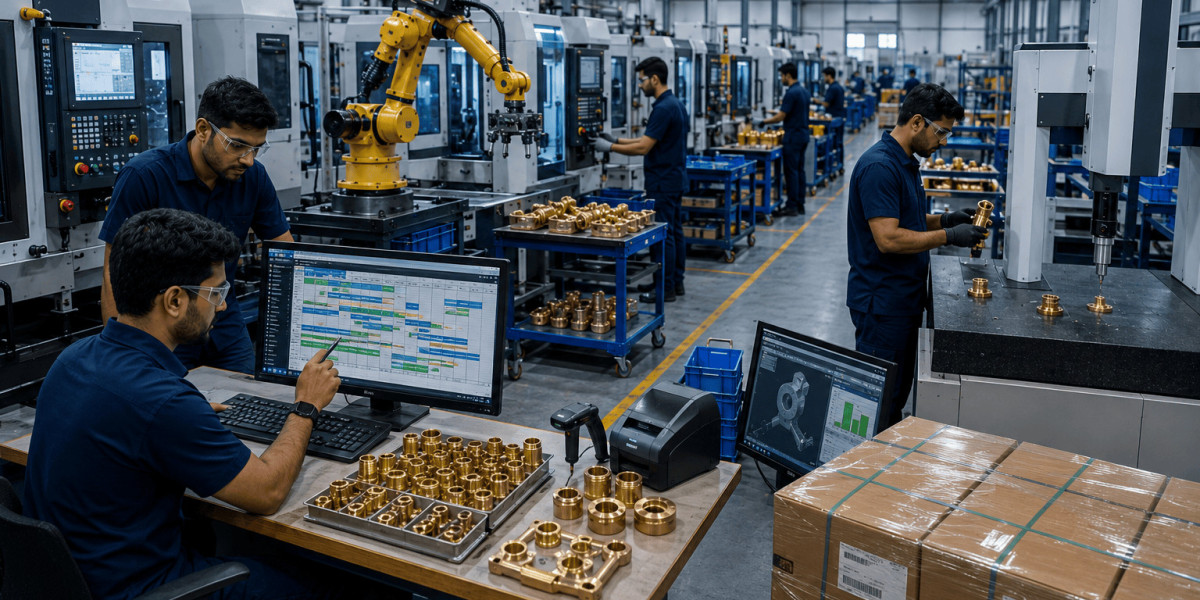

In today's competitive manufacturing landscape, maintaining consistent product quality is essential for building customer trust and achieving long-term business success. Companies across industries are continually looking for efficient ways to improve production while reducing operational costs and maintaining strict quality standards. Contract Manufacturing has emerged as a strategic solution that enables businesses to achieve these objectives by partnering with experienced manufacturing specialists.
Whether producing precision brass components, industrial fittings, electrical parts, or custom-engineered products, contract manufacturing provides businesses with access to advanced production capabilities, skilled engineering expertise, and reliable quality control systems without investing heavily in their own manufacturing infrastructure.
What Is Contract Manufacturing?
Contract manufacturing is a business arrangement in which a company outsources the production of its products or components to a specialized manufacturer. The manufacturing partner produces components according to the client's technical drawings, specifications, materials, and quality requirements while ensuring consistent production standards throughout the manufacturing process.
This approach allows businesses to focus on product development, marketing, customer relationships, and business growth while experienced manufacturers handle production efficiently.
Why Production Consistency Matters
Consistent manufacturing quality directly impacts product performance, customer satisfaction, and brand reputation. Variations in dimensions, material quality, or finishing can lead to product failures, costly recalls, and increased maintenance expenses.
Contract manufacturing partners implement standardized production procedures that ensure every component meets the required specifications, regardless of production volume.
Benefits of Contract Manufacturing
Access to Advanced Manufacturing Technology
Professional contract manufacturers invest in modern production equipment such as CNC turning, CNC milling, precision machining, forging, extrusion, automated inspection systems, and advanced surface finishing technologies.
These capabilities ensure every component is manufactured with high accuracy and repeatability.
Strict Quality Control
Reliable contract manufacturers follow comprehensive quality management systems that include:
Incoming material inspection
In-process quality checks
Precision dimensional measurement
Surface finish inspection
Final product verification
Batch traceability
These procedures minimize defects and ensure consistent product quality across every production run.
Cost Efficiency
Building and maintaining a fully equipped manufacturing facility requires significant investment. Contract manufacturing eliminates many capital expenses by allowing businesses to leverage an established manufacturer's infrastructure, equipment, and technical expertise.
This results in lower production costs and improved profitability.
Faster Production and Scalability
As market demand changes, contract manufacturers can quickly adjust production capacity to meet customer requirements. Whether manufacturing prototypes, small batches, or large production volumes, businesses benefit from flexible and scalable manufacturing solutions.
Industries That Benefit from Contract Manufacturing
Contract manufacturing supports a broad range of industries that require precision-engineered components.
Electrical Industry
Manufacturers rely on contract partners for terminals, connectors, switchgear components, electrical fittings, and precision brass parts.
Automotive Industry
Automotive companies outsource the production of custom-engineered components to maintain consistent quality while improving production efficiency.
Plumbing and HVAC
Precision fittings, valves, adapters, and fluid control components require reliable manufacturing processes that ensure durability and leak-free performance.
Industrial Machinery
Heavy equipment manufacturers benefit from contract manufacturing by obtaining high-quality precision parts that support reliable machine performance and long service life.
The Importance of Engineering Expertise
Beyond manufacturing, experienced contract manufacturers provide valuable engineering support throughout the product lifecycle. They assist with design optimization, material selection, production planning, prototyping, and process improvements to ensure products are both manufacturable and cost-effective.
This collaborative approach reduces production challenges while enhancing overall product quality.
Choosing the Right Contract Manufacturing Partner
Selecting a trusted manufacturing partner requires evaluating several important factors, including technical expertise, production capacity, quality certifications, modern machinery, customization capabilities, and on-time delivery performance.
A dependable contract manufacturer becomes an extension of your business by consistently delivering precision-engineered products that meet customer expectations and industry standards.
Conclusion
Contract manufacturing has become an essential strategy for businesses seeking consistent production quality, improved operational efficiency, and scalable manufacturing solutions. By leveraging advanced technology, skilled engineering teams, and rigorous quality control processes, companies can deliver reliable products while focusing on innovation and business growth. Partnering with Ishita Industries provides access to world-class Contract Manufacturing services backed by decades of manufacturing expertise, precision engineering, and an unwavering commitment to delivering high-quality industrial components that exceed customer expectations.






