
A training blast at a coastal ammunition depot once sent a pressure wave down an intake shaft. I was on-site the next day watching teams check air handling units; a blast valve had slammed shut and the shelter inside smelled of diesel and stale air until systems were reset. That immediate loss of ventilation is exactly the practical question operators ask: what happens to air quality when blast valves close?
What blast valves are
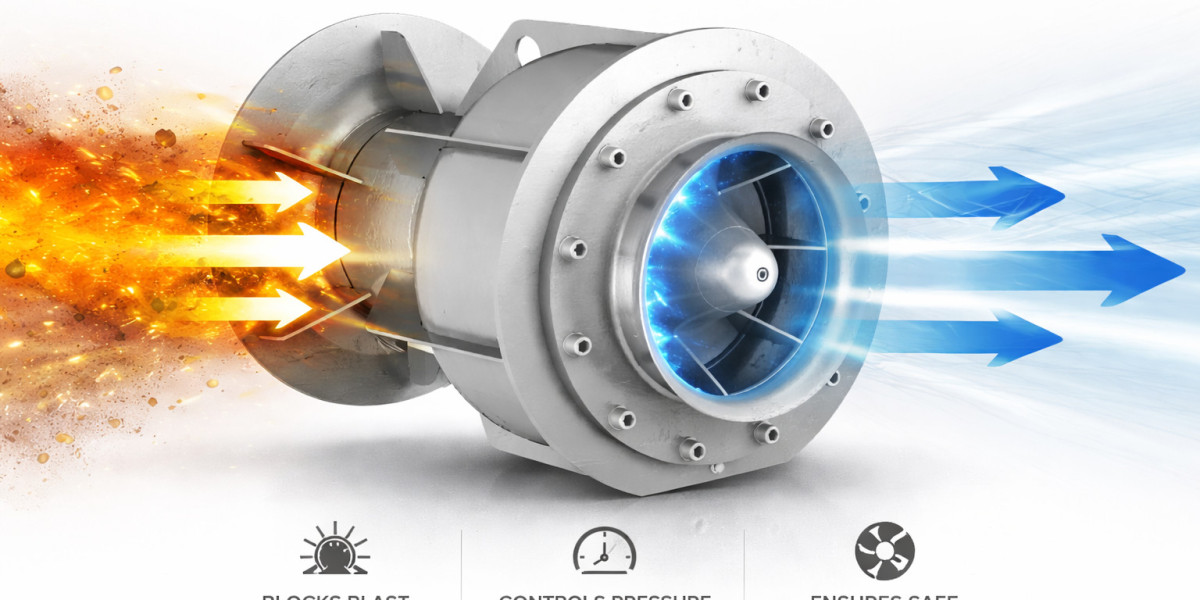
Blast valves are purpose-built devices fitted into ductwork to block a transient overpressure (shockwave) while allowing normal ventilation the rest of the time. They’re not regular dampers, blast gates or simple isolation gates. Their function is focused: prevent the blast’s peak and impulse from entering a protected volume, then reopen so ventilation resumes.
How they work under explosion pressure
Under normal conditions the valve stays open for free airflow.
When a shockwave arrives, the rapid differential pressure forces the actuator or mechanical element (flap, louver stack, weighted plate) to slam into its seat. Closure is passive and near-instant — typically milliseconds — using inertia, springs, or counterweights.
The valve holds during the high-pressure phase, resisting both peak overpressure (kPa) and impulse (kPa·ms). Once the transient passes and pressure equalizes, return mechanisms reopen the valve and restore flow.
Practical effect on air quality
Immediate reduction in fresh air: when a blast valve closes, supply or exhaust flow through that duct essentially stops, so fresh air delivery falls to zero through that path.
Short-term rise in contaminants: for occupied spaces this means CO2, humidity, body odors, and any off-gassing from equipment will start accumulating. In industrial sites, fumes from process equipment or trapped combustion products can also concentrate.
Pressure balance shifts: closed valves change building pressurization. Protected rooms may become slightly pressurized or depressurized relative to adjacent spaces depending on remaining ventilation, causing infiltration through other routes (doors, cable penetrations).
Temperature and thermal comfort: depending on HVAC configuration, temperature control will degrade — conditioned air may not be replenished, leading to warm or cold spots.
Reopening and recovery: good blast valves are designed to reopen quickly. However, recovery of normal air quality often requires fans to ramp back up and any automated controls to reset. If the closure triggered shutdowns of other AHU components, an operator action may be needed.
Key features that affect post-closure air quality
Pressure resistance — a valve must meet specified peak overpressure and impulse ratings. If the valve leaks or deforms, contaminated air and overpressure can enter the protected space.
Sealing efficiency — tight seating minimizes leakage during closure and reduces contamination ingress from ducts and external sources.
Airflow management — the valve’s free area, pressure drop and how quickly it reopens determine how fast air quality recovers after an event.
Durability and return-to-service — valves that stick or require manual reset prolong poor indoor air quality. Look for tested cyclic performance.
Corrosion resistance and materials — in coastal or chemical plants, corroded mechanisms can seize, preventing reopening and long-term ventilation loss.
Structural strength — prevents flexing under load that would create gaps or damage ductwork, both of which worsen infiltration paths.
Where blast valves are used
blast valve for bunker — hardened shelters and underground command centers rely on valves to protect life-critical spaces.
blast valve HVAC — industrial HVAC installations on petrochemical plants, compressor houses, and intake shafts use valves to prevent blast propagation into occupied or sensitive areas.
Other uses: power plants, ammunition depots, metro tunnel cross-passages, and hazardous chemical processing units where controlling shockwave entry is required.
Factors affecting blast valve price in India
Blast valve price depends on multiple practical variables:
Material quality — mild steel bodies vs 316L stainless or duplex alloys; coatings for marine or chemical environments increase cost.
Pressure rating — valves tested and certified for higher peak overpressures and impulse carry a premium.
Valve design complexity — multi-blade stacks, staged closure, or heavy counterweights add manufacturing complexity and cost.
Custom engineering — flange adaptors, inspection ports, and retrofit housings for existing ducts raise price.
Certification and testing — third-party blast test reports, NATO/EN or equivalent testing increases cost but is essential for high-risk projects.
Installation environment — confined sites, underground shafts, or high-elevation installs require additional labour and accessories.
Size and airflow capacity — larger diameters and higher free-area requirements increase material and fabrication cost.
How to choose blast valve manufacturers in India
Check industry experience — past projects in defense, petrochemical, or power demonstrate capability.
Ask for test reports — shock tube or field blast tests with matching peak and impulse figures. No report, no trust.
Verify engineering standards and QA — welding codes, material traceability and dimensional control matter for performance.
Customization capability — can they provide installation drawings and adapt the valve to your ductwork and AHU layout?
After-sales and spares — ask about spare seats, seals, and service training. Valve access for inspection should be straightforward.
Long-term reliability — request references where valves returned to service after an event and functioned without major intervention.
Common mistakes to avoid
Choosing based only on price — low blast valve price often hides insufficient testing or cheaper materials.
Ignoring pressure & impulse specs — a static rating is not enough; dynamic performance is what protects people.
Poor compatibility with HVAC systems — oversized pressure drop or incorrect flange interfaces disrupt ventilation balance.
Confusing a blast gate or blast damper with a blast valve — dampers and gates are not designed for shock loading and will likely fail.
Overlooking maintenance — valves in dusty, coastal or corrosive environments need proactive inspection and lubrication.
A quirky note on "blast valve hot air balloon"
You may see odd search terms — "blast valve hot air balloon" — usually from curiosity about valves dealing with strong updrafts or pressure pulses. The engineering principle is the same: manage transient pressure without relying on active power. But a hot-air balloon environment is not a common industrial use case for purpose-built blast valves.