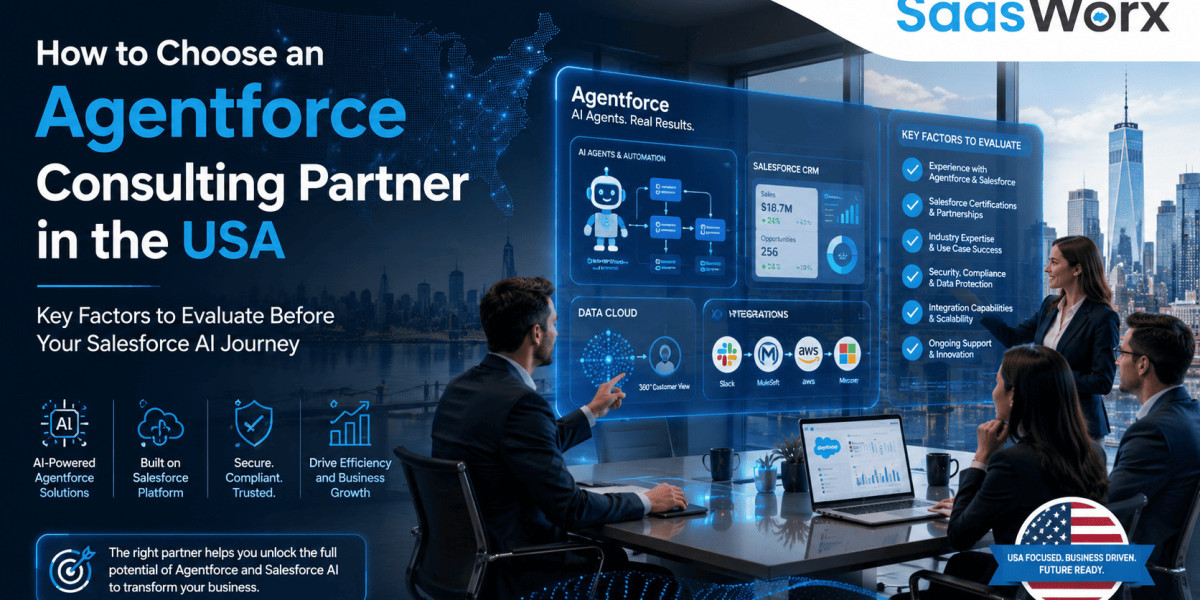

Choosing the right Agentforce consulting partner in the USA directly affects how fast your AI agents go live and how well they perform. The wrong partner wastes months of deployment time and budget. The right one gets your team productive on Salesforce Agentforce within weeks.
AI agent adoption in enterprise CRM is accelerating. According to Salesforce's own State of AI report, 83% of sales teams using AI automation reported productivity gains within the first quarter of deployment. Yet most companies still pick a partner based on price alone and pay for it later.
This post covers what an Agentforce consulting partner actually does, what credentials to look for, the questions you must ask before signing, and the warning signs most buyers miss.
What Does an Agentforce Consulting Partner Do?
An Agentforce consulting partner designs, builds, and deploys autonomous AI agents within your Salesforce environment. They map your business processes, configure agent workflows, integrate data sources, and train your team on the platform.
Their job does not stop at go-live. A qualified partner also runs post-deployment testing, monitors agent performance, and iterates on agent prompts and logic as your needs change.
The Difference Between a Salesforce Partner and an Agentforce Specialist
Not every Salesforce partner knows Agentforce. The platform only launched in full in late 2023. Many certified Salesforce partners have deep CRM expertise but limited hands-on Agentforce experience.
An Agentforce specialist has completed Salesforce's Agentforce-specific training, holds relevant AI associate or specialist credentials, and critically has real deployment case studies on the platform. Ask directly: how many Agentforce implementations have you completed in the last 12 months?
Why Industry Experience Matters More Than Certification Alone
Agentforce behaves differently across industries. A financial services firm needs agents built around compliance constraints. A retail company needs agents optimised for high-volume transactional workflows. A partner who only knows one vertical will miss the edge cases specific to yours.
Look for case studies from companies your size, in your sector. If they cannot provide them, that is a clear signal to keep looking.
How Do I Choose a Salesforce Agentforce Partner in the USA?
Start with the Salesforce AppExchange partner directory. Filter by Agentforce certifications and USA-based delivery teams. Then narrow your list using three criteria: proven deployments, technical depth, and post-go-live support structure.
Do not select a partner based on pitch deck quality. Select based on what they have already built and who can verify it.
Certifications and Credentials to Look For
Salesforce offers several credentials directly relevant to Agentforce work. These include the Salesforce AI Associate, Salesforce AI Specialist, and Agentforce Specialist certifications. A delivery team handling your implementation should hold at least one of these per consultant assigned to your project.
Also check whether the partner holds Navigator or Summit tier status in the Salesforce Partner Program. Higher-tier partners receive earlier access to product updates and direct Salesforce engineering support both of which matter when you hit technical issues.
Questions to Ask Before Signing
Ask these before you commit to any contract:
- What is your standard Agentforce implementation timeline for a company our size?
- Who specifically will work on our project, and what are their individual certifications?
- How do you handle agent performance issues post-deployment?
- Can you provide two client references from completed Agentforce projects?
- What does your handover and documentation process look like?
If any of these questions produce vague or deflecting answers, that is a red flag. Strong partners answer these without hesitation.
What Certifications Should an Agentforce Partner Have?
The minimum credential bar for a credible Agentforce consulting partner in the USA is the Salesforce AI Specialist certification, combined with verifiable deployment experience on the Agentforce platform.
Beyond individual certifications, look at the team structure. A solo certified consultant with no support team creates delivery risk. You want a partner with a bench someone who can step in if your primary contact is unavailable.
Understanding the Salesforce Partner Tiers
Salesforce uses a tiered partner program: Base, Ridge, Crest, and Summit (formerly Silver, Gold, Platinum, Global Strategic). Partner tier is determined by a combination of customer satisfaction scores, certifications held, and annual revenue on the platform.
For Agentforce implementations, aim for Crest or Summit partners where possible. That said, a smaller Ridge-tier partner with deep Agentforce specialisation will often outperform a large Summit partner that treats your project as a low-priority engagement.
Red Flags to Watch For
Watch for partners who cannot name the Salesforce credentials held by their Agentforce team. Watch for vague statements about "AI expertise" without specific platform references. Watch for contracts that bill by the hour with no defined deliverables a sign the partner lacks a structured methodology.
Resources like the Salesforce Partner Trust site and the Salesforce AppExchange partner review section give you peer-validated data on partner quality before you ever take a sales call.
How Long Does an Agentforce Implementation Take?
A standard Agentforce implementation for a mid-size business in the USA takes between six and twelve weeks from kickoff to go-live. Complex multi-agent deployments with deep CRM integration can run sixteen weeks or more.
The biggest delays in enterprise AI agent deployment come from data readiness issues, not the platform itself. Before engaging a partner, audit your Salesforce data quality. Clean, structured data cuts implementation time significantly.
What Affects the Implementation Timeline
Three factors drive timeline length: the number of agents being built, the complexity of your existing Salesforce configuration, and how prepared your internal team is for change management. Partners who skip the discovery phase to start billing faster almost always extend the total project timeline.
A good partner spends the first two weeks in discovery mapping workflows, identifying data gaps, and confirming integration requirements. This upfront investment consistently reduces total project duration. Research from McKinsey indicates that structured AI deployment planning reduces implementation overruns by up to 35% compared to ad hoc approaches.
Post-Implementation Support: What to Include in Your Contract
Negotiate a minimum 90-day post-go-live support period into any Agentforce consulting contract. This window covers agent tuning, user adoption support, and bug resolution. Without it, you absorb all post-launch risk.
Conclusion
Choosing an Agentforce consulting partner in the USA comes down to three things: verified platform experience, the right certifications on the delivery team, and a structured support model that extends beyond go-live. Price matters, but it is rarely the variable that determines success or failure. As AI agent adoption grows across enterprise CRM, the gap between strong and weak implementations will only widen. The partner you choose today shapes how your team operates for the next several years.