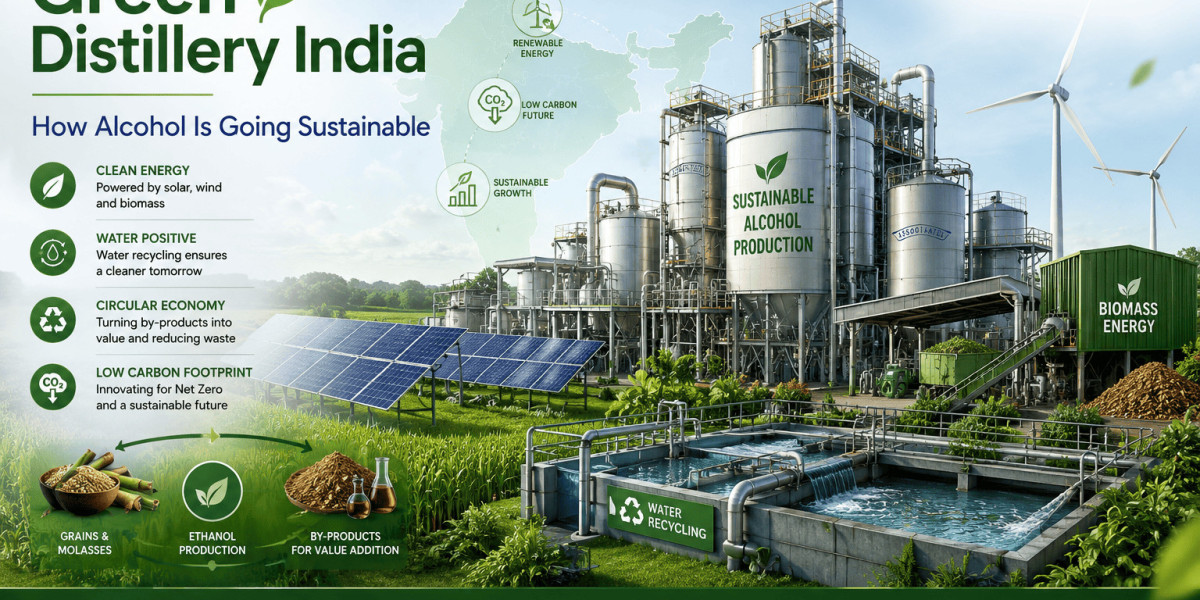

India's alcohol industry uses an estimated 15–20 litres of water per litre of alcohol produced. That number is now under serious pressure. Distilleries across the country face tightening environmental regulations, rising input costs, and growing investor scrutiny around ESG performance. The green distillery movement in India is responding directly to these pressures. This post covers what defines a green distillery, how Indian producers are cutting emissions and waste, and what the shift means for the wider alcohol industry.
What Makes a Distillery "Green" or Sustainable?
A green distillery reduces its environmental impact across energy use, water consumption, and waste generation without sacrificing output quality. It typically operates with renewable energy sources, recycles process water, treats effluent on-site, and converts organic waste into usable energy or compost.
The term covers a range of practices rather than one fixed standard. A distillery may qualify as green by meeting Zero Liquid Discharge (ZLD) norms mandated by India's Central Pollution Control Board, by achieving a certified reduction in greenhouse gas emissions, or by sourcing a defined share of electricity from solar or wind. The Bureau of Energy Efficiency (BEE) also runs the Perform, Achieve and Trade (PAT) scheme, which pushes large industrial units including distilleries to hit specific energy intensity targets.
Key criteria used to assess green distillery status
Assessors typically look at three areas: energy sourcing (what percentage comes from renewables), water intensity (litres consumed per litre of alcohol produced), and effluent treatment (whether the unit meets ZLD norms or achieves safe discharge standards). Life Cycle Assessment (LCA) methodology is increasingly used to measure total environmental impact from raw material sourcing through to bottling.
How green certification differs from regulatory compliance
Meeting pollution control norms is the legal baseline. Green certification goes further it involves third-party audits, voluntary carbon accounting, and in some cases alignment with international ESG reporting frameworks. Producers pursuing export markets face additional scrutiny from buyers in the EU and UK, where supply chain sustainability is now part of procurement criteria.
How Do Indian Distilleries Reduce Their Environmental Impact?
Indian distilleries reduce environmental impact primarily through three interventions: switching to renewable energy, installing effluent treatment and ZLD systems, and converting distillery spent wash into biogas or compost.
Spent wash the liquid byproduct of fermentation has historically been one of the most polluting outputs of Indian distilleries. It has a very high biological oxygen demand (BOD) and, when discharged untreated into water bodies, causes significant ecological damage. Modern treatment systems convert spent wash into biogas through anaerobic digestion, which is then used to generate electricity or heat for the same facility.
Renewable energy adoption in distillery operations
Solar installations are the most common renewable investment. A mid-sized distillery with rooftop solar can offset 20–30% of daytime electricity demand. Some larger units have moved to biomass-based cogeneration, burning press mud or bagasse from associated sugarcane operations to generate both steam and power. This closed-loop model significantly cuts both fuel costs and emissions.
Water recycling and Zero Liquid Discharge systems
ZLD systems treat and recycle virtually all process water, eliminating liquid effluent discharge. India's National Green Tribunal has pushed ZLD compliance across distilleries in water-stressed regions. One well-documented approach used by producers following sustainable operational models detailed further in this overview of green production practices integrates condensate recovery, reverse osmosis, and evaporation systems to achieve near-total water recycling.
What Is the Carbon Footprint of Alcohol Production in India?
Alcohol production in India generates carbon emissions primarily through fossil fuel combustion for heat and power, methane from untreated organic waste, and transportation of raw materials and finished goods. The exact footprint varies significantly by production method and scale.
A grain-based neutral spirit plant produces different emissions per litre than a molasses-based one. Molasses distilleries, common in sugarcane-producing states, can achieve lower net emissions when they use bagasse for cogeneration effectively using agricultural waste as fuel. Grain-based plants rely more heavily on grid electricity and external fuel, which currently carries a higher carbon intensity in India's energy mix.
Scope 1, 2, and 3 emissions in distillery operations
Scope 1 emissions come directly from combustion on-site boilers, generators, and vehicles. Scope 2 covers purchased electricity. Scope 3 includes raw material supply chains, packaging, and distribution. Most Indian distilleries currently measure and report only Scope 1 and 2. As ESG reporting standards tighten particularly under India's Business Responsibility and Sustainability Reporting (BRSR) framework Scope 3 disclosure is becoming harder to avoid.
Are Indian Alcohol Producers Adopting ESG Standards?
Yes. ESG adoption in India's alcohol sector has accelerated since 2021, driven by SEBI's BRSR mandate for listed companies, pressure from institutional investors, and export market requirements. Larger producers now publish annual sustainability reports and set measurable targets for emissions, water use, and waste diversion.
Smaller distilleries face more barriers upfront capital costs for ZLD systems and renewable installations are significant, and access to green financing remains uneven. The government's Production Linked Incentive (PLI) discussions for food processing have touched on sustainability criteria, though distilleries have not yet been included explicitly.
What ESG expectations mean for distillery procurement and supply chains
Buyers particularly multinational spirits companies sourcing Indian grain neutral spirit are beginning to include sustainability audits in supplier qualification processes. This creates a downstream pressure on contract distillers to document and improve their environmental performance even if they are not independently listed or subject to BRSR.
Conclusion
Green distillery practices in India are no longer voluntary experiments they are responses to regulatory pressure, market expectations, and resource economics. The alcohol industry faces real constraints on water, energy, and waste management that make sustainability a core operational issue. Producers who invest early in ZLD systems, renewable energy, and carbon accounting are building resilience that their peers will eventually be forced to match. The question for the sector is not whether green distillery operations become the norm in India, but how quickly that transition happens and who drives it.