
Introduction
A hash generator is one of the most quietly powerful tools on the modern web turning any piece of text or file into a fixed-length fingerprint in milliseconds. Whether you are verifying file integrity, storing passwords securely, or checking data consistency, understanding how a hash generator works gives you a significant advantage. This guide answers the most common questions about hashing so you can use these tools with confidence.
Understanding Hash Functions and How They Work
What exactly is a hash generator?
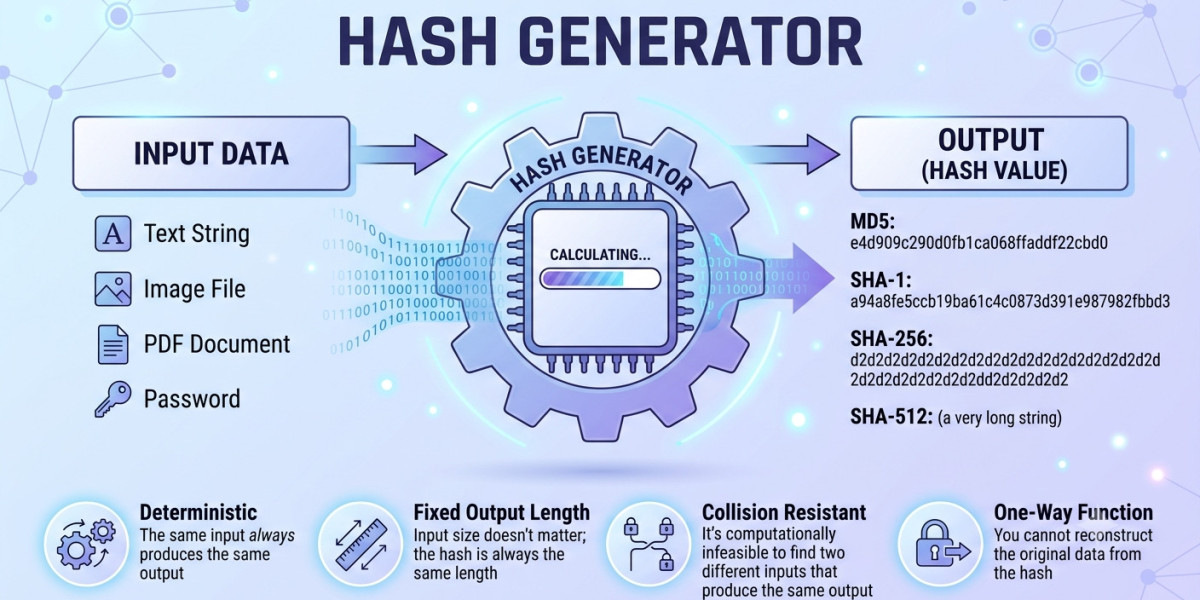
A hash generator is a tool or algorithm that takes an input such as a word, sentence, file, or password and converts it into a fixed-length string of characters called a hash or digest. Hash Generator This output looks like a random sequence of letters and numbers, but it is always the same for the same input. Tools like those available on multiconverters.net make this process available instantly in your browser, no installation required.
How does a hash function produce its output?
A hash function runs your input through a mathematical algorithm that maps data of any size to a fixed-size result. The process is deterministic, meaning the same input will always produce the same hash, yet even a single character change will produce a completely different output. This sensitivity to change is what makes hash generators so useful for detecting tampering or corruption.
Is hashing the same as encryption?
No hashing and encryption are fundamentally different processes. Encryption is a two-way operation where data can be decrypted using a key, while hashing is a one-way function that cannot be reversed. Once you put data through a hash generator, you cannot reconstruct the original input from the hash alone, which is why hashing is preferred for password storage rather than encryption.
Common Hash Algorithms and Their Differences
What is MD5 and when should it be used?
MD5 (Message Digest 5) is one of the oldest and most widely recognized hashing algorithms, producing a 128-bit hash value typically shown as a 32-character hexadecimal string. While it was once a standard for checksums and data verification, MD5 is no longer considered cryptographically secure for sensitive applications like password hashing. It remains useful for non-security tasks such as quickly verifying that a downloaded file has not been corrupted.
What makes SHA-256 more secure than MD5?
SHA-256 belongs to the SHA-2 family and produces a 256-bit hash, making it far more resistant to collision attacks than MD5. A collision occurs when two different inputs produce the same hash output, and SHA-256's larger output space makes this statistically impractical with current computing power. Most modern applications, blockchain systems, and SSL certificates rely on SHA-256 as a reliable standard.
What are SHA-1 and SHA-512, and where do they fit in?
SHA-1 produces a 160-bit hash and was widely used throughout the 2000s, but it has known vulnerabilities and is now considered deprecated for security-critical uses. SHA-512 offers a 512-bit output and is the strongest member of the SHA-2 family, making it ideal for applications requiring the highest level of integrity assurance. When using an online hash generator, choosing between these algorithms depends on the balance you need between speed and security strength.
Practical Uses of a Hash Generator
How do developers use hashing for password security?
Instead of storing a user's actual password in a database, developers store its hash value typically using algorithms like bcrypt, SHA-256, or Argon2. When a user logs in, the system hashes the entered password and compares it to the stored hash, never touching the original value. This means that even if a database is breached, attackers only obtain hashes rather than plain-text passwords.
Can a hash generator verify file integrity?
Yes, and this is one of its most practical everyday uses. When you download software or a large file, the provider often publishes a checksum hash alongside it. You run the downloaded file through a hash generator using the same algorithm, and if your result matches the published hash exactly, the file is intact and unmodified. Any difference even a single flipped bit produces a completely different hash, immediately signaling a problem.
How is hashing used in digital forensics and data deduplication?
In digital forensics, investigators hash files and disk images to create a verifiable record of evidence that proves data was not altered after collection. In data storage systems, hashing enables deduplication by identifying identical files through their hash values, eliminating redundant copies and saving significant storage space. A reliable hash generator is therefore a tool used across fields ranging from cybersecurity to cloud storage management.
Using Online Hash Generator Tools
What should I look for in a good online hash generator?
A trustworthy online hash generator should support multiple algorithms at minimum MD5, SHA-1, SHA-256, and SHA-512 and process your input entirely in the browser so your data never leaves your device. Speed, a clean interface, and the ability to hash both text strings and uploaded files are features that separate a professional tool from a basic one. Platforms like multiconverters.net are built around exactly this kind of versatility and user convenience.
Can I hash an entire file using an online tool?
Many modern online hash generators support file uploads in addition to plain text, allowing you to drag and drop a file and receive its hash digest instantly. Client-side processing ensures that the file content is hashed locally without being sent to any server, which is important when working with sensitive documents. Always verify that the tool you are using processes files locally before uploading anything confidential.
Is it safe to use a free online hash generator?
For most general purposes verifying downloads, creating checksums for text, or learning how hashing works a reputable free online hash generator is perfectly safe. You should avoid pasting highly sensitive data such as live passwords or private keys into any online tool unless you are certain of client-side processing. For production security workflows involving critical data, integrating a hashing library directly into your application is always the more controlled approach.
Also Check out : Multiconverters
Conclusion
A hash generator is far more than a niche developer utility it is a foundational tool for data integrity, security, and verification that anyone working with digital information should understand. From choosing the right algorithm like SHA-256 to verifying file checksums and protecting user passwords, the applications of hashing are broad and genuinely impactful. Explore the free hash generator and other powerful utilities at multiconverters.net to start putting these concepts into immediate, practical use.






fatimamkgh 5 d
A hash generator is far more than a niche developer utility it is a foundational tool for data integrity, security, and verification that anyone working with digital information should understand. From choosing the right algorithm like SHA-256 to verifying file checksums and protecting user passwords, the applications of hashing are broad and genuinely impactful. Explore the free hash generator and other powerful utilities at multiconverters.net to start putting these concepts into immediate, practical use.