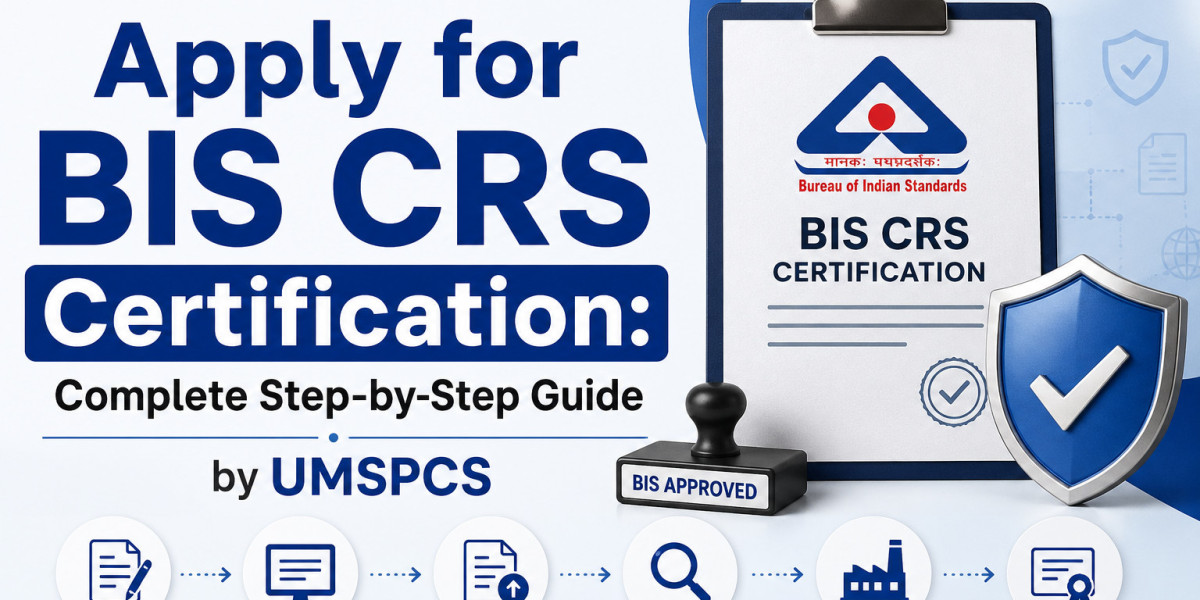

If you manufacture or import electronic and IT products in India, obtaining BIS CRS Certification is mandatory before legally selling your products in the Indian market. The Compulsory Registration Scheme (CRS), administered by the Bureau of Indian Standards (BIS), ensures that electronic products comply with Indian safety and quality requirements.
However, the certification process can be complex due to evolving regulations, technical testing requirements, and extensive documentation. This is where UMSPCS, a trusted BIS CRS Certification Consultant in India, simplifies the entire process for manufacturers and importers.
In this guide, we explain the complete BIS CRS certification process step by step.
What is BIS CRS Certification?
BIS CRS (Compulsory Registration Scheme) is a mandatory registration program introduced by BIS for specified electronic and IT products. Under this scheme, products must be tested in BIS-recognized laboratories and registered with BIS before they can be sold in India.
After successful approval, manufacturers receive a BIS Registration Number and are authorized to use the Standard Mark on their products and packaging.
UMSPCS provides complete assistance for obtaining BIS CRS Certification for both Indian and foreign manufacturers.
Products Covered Under BIS CRS Certification
The list of products covered under CRS continues to expand. Some commonly registered products include:
Mobile Phones
Tablets
LED Bulbs and Lamps
LED Drivers
Power Banks
Chargers and Adapters
Laptops and Notebooks
CCTV Cameras
Smart Watches
Bluetooth Speakers
Headphones and Earphones
Set-Top Boxes
Wireless Keyboards and Mice
Batteries and Secondary Cells
If you are unsure whether your product requires CRS registration, UMSPCS can help determine the applicable Indian Standard and certification requirements.
Read More :- BIS-ISI Certification For SKIMMED MILK POWDER
Documents Required for BIS CRS Certification
To apply for BIS CRS Registration, the following documents are generally required:
Company Documents
GST Registration Certificate
Company PAN Card
Business Registration Certificate
Manufacturing Unit Address Proof
Authorized Signatory Documents
Identity Proof
Authorization Letter
Product Documents
Technical Specifications
Product Datasheet
Circuit Diagram
PCB Layout
Critical Component List
Product Label Details
Additional Documents
Trademark Registration in India (if applicable)
Brand Authorization Letter (if applicable)
BIS Laboratory Test Reports
For Foreign Manufacturers
Authorized Indian Representative (AIR) Appointment Documents
UMSPCS reviews and verifies all documentation to minimize the risk of rejection.
Step-by-Step Process to Apply for BIS CRS Certification
Step 1: Identify the Applicable Indian Standard
The first step is determining whether the product falls under the CRS scheme and identifying the correct Indian Standard (IS Code).
Selecting an incorrect standard can result in application rejection. UMSPCS helps businesses identify the right standard accurately.
Step 2: Appoint an Authorized Indian Representative (AIR)
Foreign manufacturers must appoint an Authorized Indian Representative (AIR) to represent them before BIS.
The AIR acts as the local contact and assumes responsibility for compliance within India.
Step 3: Product Testing in a BIS-Recognized Laboratory
A product sample must be submitted to a BIS-approved laboratory for testing.
The laboratory evaluates whether the product complies with the applicable Indian Standard and issues a test report upon successful completion.
This test report forms the foundation of the BIS CRS application.
Step 4: Register on the BIS Online Portal
Manufacturers must create an account on the BIS online portal to initiate the certification process.
Accurate company and product information should be entered during registration.
Step 5: Submit the CRS Application
Complete the online application form and upload:
Test Reports
Company Documents
Product Documents
Authorization Documents
All information must match the supporting documents to avoid delays.
Step 6: Payment of Government Fees
The applicable BIS registration fees and government charges must be paid online during application submission.
Step 7: BIS Review and Verification
BIS officials review:
Application Details
Product Test Reports
Supporting Documents
If any discrepancies are found, BIS may raise technical queries requiring clarification.
Prompt responses significantly improve approval timelines.
Step 8: Grant of BIS Registration Certificate
After successful verification, BIS issues the CRS Registration Certificate along with a unique registration number.
Manufacturers can then legally affix the BIS Standard Mark to their products and packaging.
BIS CRS Certification Timeline
Typically, BIS CRS Certification takes approximately 20–40 working days, depending on:
Product Testing Duration
Document Accuracy
BIS Query Resolution Time
Product Category Complexity
With professional guidance from UMSPCS, the process can be completed more efficiently while reducing unnecessary delays.
Common Reasons for BIS CRS Application Rejection
Many applications face delays or rejection due to:
Incorrect Indian Standard Selection
Incomplete Documentation
Errors in Application Forms
Invalid or Expired Test Reports
Testing Conducted at Non-Recognized Laboratories
Delayed Response to BIS Queries
Incorrect AIR Details for Foreign Manufacturers
Working with experienced consultants helps avoid these common issues.
Why Choose UMSPCS for BIS CRS Certification?
UMSPCS is a leading BIS Certification Consultant in India offering end-to-end support for CRS Registration.
Our Key Advantages
✔ Expert Knowledge of BIS Regulations
✔ Assistance for Indian & Foreign Manufacturers
✔ Coordination with BIS-Recognized Laboratories
✔ Accurate Documentation Support
✔ Fast Application Processing
✔ High Approval Success Rate
✔ Transparent Pricing Structure
✔ Dedicated Query Resolution Support
✔ Renewal and Compliance Assistance
Whether you are a startup, importer, OEM manufacturer, or global electronics brand, UMSPCS ensures a smooth and hassle-free certification process.
Conclusion
BIS CRS Certification is mandatory for many electronic and IT products sold in India. While the registration process involves technical testing, documentation, and regulatory compliance, the right guidance can make the process simple and efficient.
UMSPCS offers complete support—from product testing and documentation to application filing and final BIS approval—helping businesses achieve compliance quickly and confidently.
If you are planning to obtain BIS CRS Certification, connect with UMSPCS for expert consultation and end-to-end assistance.
Frequently Asked Questions (FAQs)
Q1. What is BIS CRS Certification?
BIS CRS Certification is a mandatory registration scheme for specified electronic and IT products to ensure compliance with Indian safety standards.
Q2. Who needs BIS CRS Registration?
Manufacturers and importers of notified electronic products such as mobile phones, LED lights, laptops, CCTV cameras, chargers, and power banks require CRS registration.
Q3. Is product testing mandatory for CRS Certification?
Yes. Products must be tested in a BIS-recognized laboratory before applying for registration.
Q4. Can foreign manufacturers obtain BIS CRS Certification?
Yes. Foreign manufacturers can apply through an Authorized Indian Representative (AIR).
Q5. How long is BIS CRS Certification valid?
The validity period depends on BIS regulations and applicable registration terms. Timely renewal is required to maintain compliance.
Q6. What is the cost of BIS CRS Certification?
The cost varies depending on the product category, testing requirements, and government fees.
Q7. What happens if products are sold without CRS Registration?
Selling notified products without CRS certification may result in penalties, product seizure, legal action, and market restrictions.
Q8. Can multiple products be covered under one application?
Generally, separate product models require separate registrations, although certain product variants may qualify under specific conditions.
Q9. How does UMSPCS assist with BIS CRS Certification?
UMSPCS provides complete support including standard identification, testing coordination, document preparation, application filing, query handling, and final approval.
Q10. Why should I choose UMSPCS?
UMSPCS offers industry expertise, faster processing, professional support, transparent pricing, and a high success rate in BIS certification projects.
Need Assistance with BIS CRS Certification?
UMSPCS – Your Trusted BIS CRS Certification Consultant
Get expert guidance for product testing, documentation, BIS registration, renewals, and compliance support.
Contact UMSPCS today for a hassle-free BIS CRS Certification process.