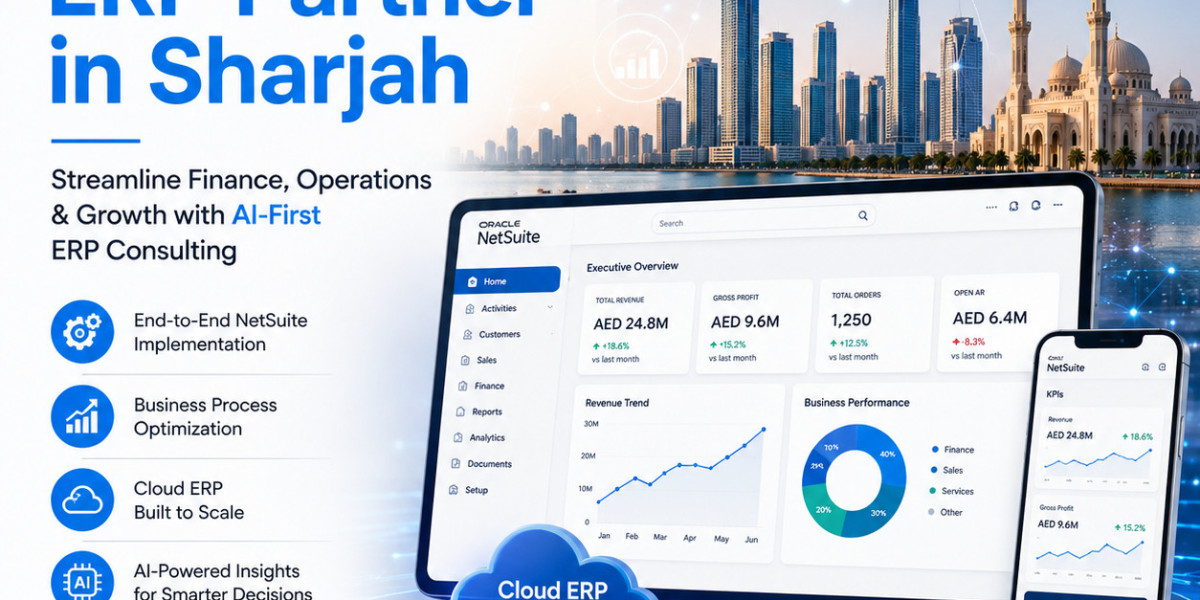

Sharjah's economy grew by over 5% in 2023, driven by manufacturing, logistics, and trade. Yet many businesses in the emirate still run on disconnected spreadsheets and legacy software. That gap is slowing growth and costing money.
Working with an Oracle NetSuite ERP partner in Sharjah gives businesses a single, cloud-based system for finance, operations, and compliance. In this post, you'll learn how NetSuite solves the most common ERP challenges in Sharjah, which industries benefit most, and what FTA compliance actually requires from your software.
What Does an Oracle NetSuite ERP Partner Do in Sharjah?
An Oracle NetSuite ERP partner in Sharjah configures, deploys, and supports your NetSuite system so it fits your specific business workflows. They handle implementation, data migration, staff training, and ongoing system optimisation. A good partner does not hand you software and walk away they stay accountable through go-live and beyond.
How Implementation Actually Works
A typical NetSuite deployment follows a structured process: discovery, configuration, user acceptance testing, and go-live. Most mid-sized Sharjah businesses go live within 90 to 120 days. The partner maps your existing workflows to NetSuite modules including financials, inventory, and procurement before any data moves.
What to Expect After Go-Live
Post-implementation support covers system updates, new module additions, and user training. As your business grows, your ERP configuration should grow with it. A qualified partner builds your system to handle multi-entity structures, currency conversions, and expanded operations without starting from scratch.
Why Local Expertise Matters
A partner who understands Sharjah's regulatory environment particularly UAE VAT rules and FTA reporting requirements reduces your compliance risk significantly. They configure tax codes, invoice formats, and audit trails to meet local standards from day one.
How Does NetSuite Help Sharjah Businesses Stay FTA Compliant?
NetSuite automates VAT calculation, generates FTA-compliant tax invoices, and maintains a full audit trail for every transaction. It supports the exact reporting formats the Federal Tax Authority requires, which removes manual tax processing from your finance team's workload entirely.
UAE VAT Compliance Built Into the System
NetSuite's tax engine handles standard-rated, zero-rated, and exempt supplies automatically. Every invoice generated meets FTA format requirements including the mandatory tax registration number, VAT amount, and invoice date. That removes the risk of human error in tax filings.
Real-Time Reporting for Audits
One of the most practical features for Sharjah businesses is real-time financial reporting. Your finance team can generate VAT returns, transaction summaries, and audit-ready reports at any point without waiting for month-end. This matters when the FTA requests documentation on short notice.
Multi-Currency and Multi-Entity Support
Many Sharjah businesses trade across UAE free zones, GCC countries, and international markets. NetSuite manages multiple currencies, intercompany transactions, and consolidated reporting across legal entities from one dashboard. That's a real operational advantage for trading and logistics companies in the northern emirates.
Is Oracle NetSuite Suitable for SMEs in the UAE?
Yes. NetSuite works for businesses from around 10 employees upward, and its modular structure means you only pay for what you use. UAE SMEs in manufacturing, retail, and professional services have adopted NetSuite specifically because it grows with them you do not need to switch platforms as you scale.
Gartner recognises NetSuite as a leading cloud ERP for fast-growing mid-market companies. That positioning reflects its ability to handle complexity without requiring enterprise-level IT infrastructure.
Starting Small, Scaling Fast
A Sharjah-based trading company can start with core financials and add inventory management, CRM, and project tracking later. Each module connects to the same data layer, so there are no integration costs between them. That modular path makes NetSuite significantly more accessible for SMEs than traditional on-premise ERP platforms.
Total Cost of Ownership
Cloud ERP eliminates the need for on-site servers, in-house IT maintenance, and costly version upgrades. According to Forrester Research, companies using cloud ERP report an average 50% reduction in IT infrastructure costs over three years. For UAE SMEs watching cash flow, that matters.
For a closer look at how an Oracle NetSuite ERP partner in Sharjah structures local deployments, this overview of NetSuite implementation for Sharjah enterprises covers the key modules and industry verticals in detail.
What Industries in Sharjah Benefit Most from NetSuite ERP?
Manufacturing, logistics, real estate, and professional services gain the most from NetSuite in Sharjah. These sectors run complex operations multi-location inventory, project-based billing, or trade finance that basic accounting tools cannot manage at scale.
Manufacturing and Supply Chain
Sharjah is one of the UAE's largest manufacturing hubs, contributing roughly 14% of the emirate's GDP. NetSuite gives manufacturers real-time visibility into production orders, raw material stock, and supplier lead times all from one screen.
Logistics and Trading Companies
Logistics firms managing cross-border shipments need precise landed cost tracking and multi-currency invoicing. NetSuite handles both, and integrates with customs documentation requirements common in the UAE's free zones.
Real Estate and Professional Services
Project-based businesses consultancies, engineering firms, property developers use NetSuite's project accounting module to track revenue recognition, resource allocation, and profitability per engagement. That level of granularity is hard to get from standard accounting software.
Conclusion
Sharjah's growth trajectory is real, and businesses that run on fragmented systems will struggle to keep pace. An Oracle NetSuite ERP partner in Sharjah gives you a single platform for finance, operations, and compliance built to handle the specific demands of UAE regulations and regional expansion. The businesses scaling fastest in the emirate are not using more tools; they are using fewer, better-connected ones. The question worth asking is not whether ERP is right for your business it is how long you can afford to wait.




