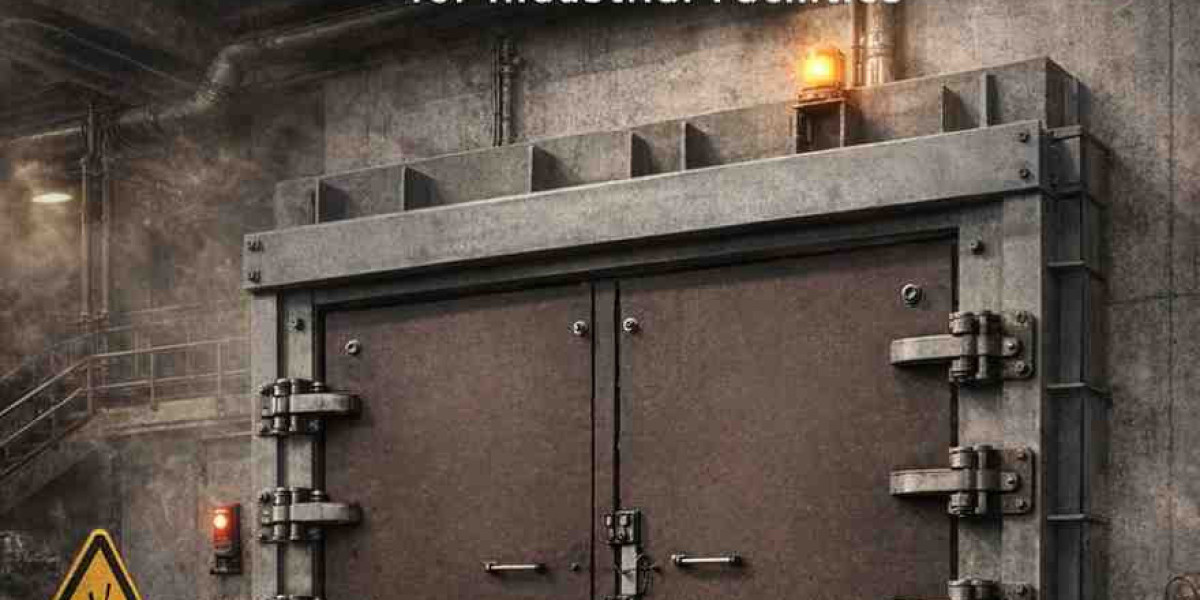

In high-risk industrial and defense environments, standard structural barriers are entirely insufficient against the catastrophic forces of an explosion. Modern industrial safety planning relies on blast resistant doors—specialized mechanical systems engineered to withstand intense shock waves, rapid pressure spikes, flying debris, and structural impact. Operating as a critical shield between hazardous operational zones and safe areas, these doors are vital for preserving human life, protecting sensitive instrumentation, and maintaining facility continuity during an incident.
Applications in High-Risk Infrastructure
Advanced protective barriers are mandatory across sectors where hazardous materials or high-energy processes are standard. Critical environments requiring these systems include:
Energy & Processing: Oil refineries, petrochemical complexes, chemical processing units, and offshore drilling platforms.
Power & Research: Nuclear and conventional power stations, specialized research laboratories, and hazardous manufacturing zones.
Defense & Security: Military installations, tactical bunkers, and command centers.
Core Structural Engineering & Specifications
The immense kinetic energy generated by an explosion demands a drastic departure from conventional door manufacturing. To successfully absorb and dissipate blast energy, a highly robust structural framework is required.
[Explosive Shock Wave] ---> (Reinforced Steel Leaf) ---> (Internal Energy Dissipation) ---> (Precision-Welded Frame)Internal Energy Dissipation: The interior door leaf is designed with heavy-duty internal steel supports and specialized composite layers. Rather than remaining completely rigid, this internal geometry is engineered to deform minimally while absorbing the brunt of the sudden positive and negative pressure waves.
Frame and Configuration Integrity: Frames are constructed from precision-welded structural steel sections to prevent the assembly from ripping away from the wall anchors. These systems are scalable and custom-sized, available in both single-leaf and double-leaf configurations depending on the clear opening requirements.
High-Endurance Finishing: Because these doors are frequently deployed in highly corrosive or exposed environments (such as coastal facilities or chemical plants), surface preservation is critical. Options range from standard anti-corrosion factory primers and industrial-grade wet paints to heavy-duty stainless steel cladding and pre-coated steel sheets.
Systems Integration and Hardware
A blast door must function reliably as a standard high-traffic entry point before an emergency, and lock down instantly when a threat occurs. To achieve this, the physical steel structure is integrated with advanced hardware and automated controls:
Operational Accessories: Heavy-duty mechanical locking hardware, self-closing devices, and door leaf coordinators ensure a positive seal. For exterior units, integrated drip caps prevent moisture ingress.
Automation & Electronics: Systems can be outfitted with automatic operators linked directly to Building Management Systems (BMS), secure access control systems, and specialized ventilation louvers engineered for both fire-rated and non-fire-rated boundaries.
The Evolution of Industrial Blast Protection
The deployment of dedicated blast protection doors dates back to the Cold War era of the 1950s, driven by military requirements for nuclear and ballistic defense. Over the decades, this technology has transitioned into the commercial and industrial sectors, evolving from over-engineered, massive blocks of concrete and iron into highly precise, scientifically modeled steel-composite systems.
Today, as global safety regulations tighten, companies like Sigma Power Tech lead the development of these high-performance safety systems. By combining heavy reinforced steel construction, precision engineering, and responsive access hardware, Sigma Power Tech manufactures tailored blast resistant doors that meet the rigorous security demands of modern industrial and defense infrastructure.
Frequently Asked Questions (FAQs)
1. What is a blast resistant door?
A blast resistant door is a specially engineered safety door designed to withstand explosions, shock waves, flying debris, and sudden pressure changes. These doors help protect personnel, equipment, and critical infrastructure in high-risk industrial and defense environments.
2. Where are blast resistant doors commonly used?
Blast resistant doors are widely used in oil refineries, petrochemical plants, chemical processing units, offshore platforms, power stations, military facilities, tactical bunkers, research laboratories, and hazardous manufacturing environments where explosion protection is essential.
3. How do blast resistant doors work?
These doors use reinforced steel construction, internal energy-dissipating supports, and precision-welded frames to absorb and reduce blast pressure. Their specialized design helps minimize structural damage while maintaining the integrity of protected areas.
4. Can blast resistant doors be customized?
Yes. Blast resistant doors are available in custom sizes, single-leaf or double-leaf configurations, and multiple finishing options including stainless steel cladding, industrial paint coatings, and corrosion-resistant treatments to suit specific project requirements.
5. What additional systems can be integrated with blast resistant doors?
Modern blast resistant doors can include heavy-duty locking hardware, self-closing systems, access control integration, automatic operators connected to Building Management Systems (BMS), and ventilation louvers for improved safety and operational efficiency.





