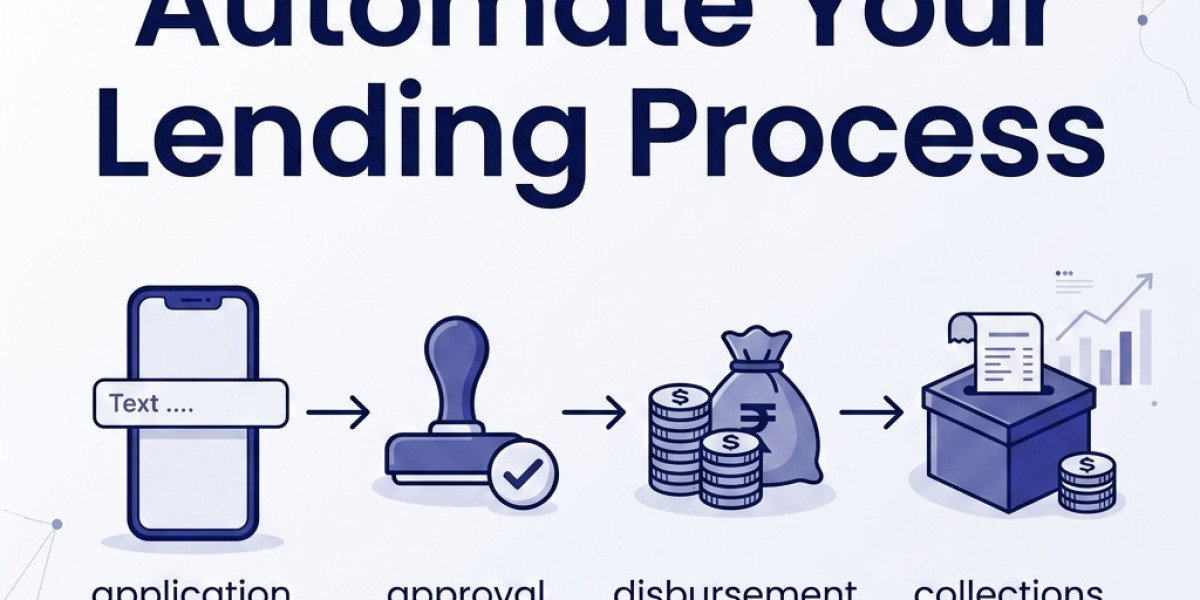

This step-by-step guide explains how to design and implement an automated loan customer journey for your NBFC — from the first application touchpoint to the final disbursement confirmation.
What Is a Loan Customer Journey?
The loan customer journey is the complete sequence of interactions a borrower goes through — from first hearing about your NBFC to receiving disbursement and making repayments. An automated loan journey replaces each manual step with a digital, system-driven process.
A fully automated journey covers:
• Multi-channel application entry (web, mobile, WhatsApp, DSA portal)
• Instant KYC verification via Aadhaar/PAN APIs
• Real-time credit bureau checks and AA data pull
• Automated credit scoring and decisioning
• Digital document collection and e-sign
• Automated sanction letter generation
• Instant disbursement to verified bank account
• Post-disbursal repayment setup via NACH/UPI AutoPay
Why Automating the Loan Journey Matters for NBFCs
Metric | Manual Process | Automated Journey | Improvement |
Disbursement TAT | 3–7 days | Minutes to hours | 90% faster |
Cost per loan | ₹1,500–3,000 | ₹200–400 | 80% lower |
Errors in documentation | 5–15% error rate | <1% error rate | Eliminates rework |
Scalability | Linear with headcount | Exponential with tech | 10x without hiring |
Borrower NPS | Low (slow, complex) | High (fast, digital) | Significantly higher |
The 8 Stages of an Automated Loan Customer Journey
Stage 1: Multi-Channel Application Entry
The journey begins when a borrower enters the funnel. A modern automated system should accept applications from multiple channels simultaneously and route them into a single origination pipeline.
Channels to support:
• Branded mobile app (iOS and Android)
• Responsive web portal
• WhatsApp chatbot (conversational application flow)
• DSA/partner portal with lead assignment
• Branch agent-assisted application (tablet-based)
Automation at this stage: pre-filled application using mobile number, automatic lead deduplication, and instant acknowledgement SMS/WhatsApp to the borrower.
Stage 2: Digital KYC (Know Your Customer)
KYC is where most manual processes break down. An automated KYC flow eliminates branch visits and paper document submission.
Automate these KYC steps:
• Aadhaar OTP eKYC — verify identity and address in seconds
• PAN card verification — NSDL/UTI database check in real-time
• Face match — compare selfie to Aadhaar photo using AI
• Video KYC (V-CIP) — for cases requiring in-person verification
• Geo-tagging — capture applicant location for fraud prevention
Roopya's automated KYC module completes all verifications in under 90 seconds, with zero manual review required for clean applications.
Stage 3: Automated Credit Assessment
Credit assessment is the most complex stage to automate, but also the highest-value. A fully automated credit assessment includes:
1. Multi-bureau credit pull — CIBIL, Experian, CRIF, Equifax simultaneously
2. Account Aggregator data pull — bank transaction history with borrower consent
3. AI bank statement analysis — income estimation, obligation mapping, irregular income detection
4. GST data analysis — for MSME borrowers, turnover and compliance verification
5. Fraud checks — device fingerprinting, IP analysis, multiple bureau de-duplication
6. Credit score computation — proprietary scorecard applied to all data points
7. Policy rule evaluation — BRE checks eligibility, flags, and overrides
The output is an automated decision: Approve (with amount and rate), Refer (for manual review), or Reject (with reasons stored for audit).
Stage 4: Offer Generation and Acceptance
Approved borrowers receive a digital loan offer in real-time — displayed in the app or sent via WhatsApp/SMS. The offer should show:
• Approved loan amount and sanction limit
• Interest rate (monthly/annual)
• EMI amount and repayment schedule preview
• Processing fee and GST breakdown
• Offer validity period
The borrower accepts the offer digitally, and this acceptance is time-stamped and stored in the audit log.
Stage 5: Digital Document Collection and Verification
After offer acceptance, the system automatically triggers a document collection checklist based on the loan product and borrower profile. OCR technology extracts data from uploaded documents — eliminating manual data entry.
• Bank statements — OCR + AI analysis for income verification
• ITR/Form 16 — income proof for salaried or self-employed
• Property documents — for LAP or home loans
• Business registration documents — for MSME loans
Automated verification checks: document authenticity, PAN consistency, bank account name match, date validations.
Stage 6: Loan Agreement and e-Sign
A compliant digital loan agreement is generated automatically using your approved templates, with all borrower-specific terms populated. The borrower signs digitally using:
• Aadhaar-based e-sign (OTP verification + UIDAI authentication)
• DSC (Digital Signature Certificate) for higher-value loans
The signed agreement is stored in the system, sent to the borrower's email, and included in the audit trail.
Stage 7: Automated Disbursement
Disbursement is triggered automatically once all conditions are met. The system verifies bank account ownership via penny drop, initiates NEFT/IMPS transfer or UPI disbursement, generates a disbursement confirmation slip, and sends the borrower an SMS/WhatsApp confirmation with reference number.
With Roopya's automated disbursement module, the entire process from offer acceptance to bank credit can complete in under 15 minutes.
Stage 8: Post-Disbursal Repayment Automation
The journey does not end at disbursement. An automated post-disbursal flow sets up:
• NACH e-mandate registration — auto-debit EMI on due date
• UPI AutoPay mandate — for UPI-enabled repayments
• Repayment reminders — automated SMS/WhatsApp 3 days before due date
• Welcome SMS — with EMI schedule, customer portal link, and helpline
• Digital repayment portal — for prepayment, foreclosure, and statement download
Technology Stack Required for Loan Journey Automation
Function | Technology Required | Roopya Provides? |
Multi-channel intake | Web, mobile, WhatsApp API | Yes — native |
KYC automation | Aadhaar, PAN, V-KYC APIs | Yes — 300+ pre-integrated |
AA data pull | Account Aggregator APIs | Yes — native AA integration |
Credit bureau | CIBIL, Experian, CRIF APIs | Yes — multi-bureau native |
AI credit scoring | ML model engine | Yes — proprietary scorecard engine |
BRE / Policy engine | No-code rule engine | Yes — self-configurable BRE |
e-Sign | Aadhaar e-sign / DSC | Yes — UIDAI integrated |
Disbursement | NEFT, IMPS, UPI APIs | Yes — payment gateway integrated |
NACH / AutoPay | NPCI NACH, UPI AutoPay | Yes — pre-integrated |
Repayment portal | White-label borrower app | Yes — included |
Common Automation Pitfalls to Avoid
Pitfall 1: Automating without a no-code BRE
If changing a credit policy requires a developer, your automation is brittle. Every policy change becomes a development sprint. A no-code Business Rule Engine allows your credit team to update eligibility criteria, interest rates, and approval thresholds in minutes.
Pitfall 2: Siloed channel automation
Many NBFCs automate the web channel but leave the DSA portal and branch channel manual. This creates two-speed processes and inconsistent borrower data. All channels must feed a single origination pipeline.
Pitfall 3: No exception handling workflow
Not every loan can be fully automated. Your system must have a clear referral path — where automated rules flag a case for manual review, with context and reason codes provided to the underwriter. This hybrid automation ensures edge cases are handled without breaking the automated flow.
Frequently Asked Questions
How long does it take to implement an automated loan journey?
With a modern platform like Roopya, a standard loan product can be configured and go live in 1 day. Complex multi-product configurations with custom BRE rules typically take 1–2 weeks. Traditional platforms can take 3–6 months.
What is the cost of loan journey automation software in India?
Modern SaaS platforms use pay-per-use pricing based on loan volume, making the entry cost very low for growing NBFCs. Traditional enterprise implementations require ₹20–80 lakh upfront in software licences plus implementation costs.
Can automation work for microfinance (JLG) loans?
Yes. Group lending and JLG loans can be automated with specific workflow configurations — group formation, joint liability verification, field agent app integration, and group meeting scheduling. Platforms like Roopya support MFI workflows natively.
Automate Your Loan Journey With Roopya See how 100+ Indian lenders have cut disbursement time from days to minutes. roopya.money/automated-customer-loan-journey |





